Winter Moth on Cape Cod: Should You Band Your Trees This November?
By Nikola Popov, agronomist and founder of Sofkin Landscaping in Hyannis, MA
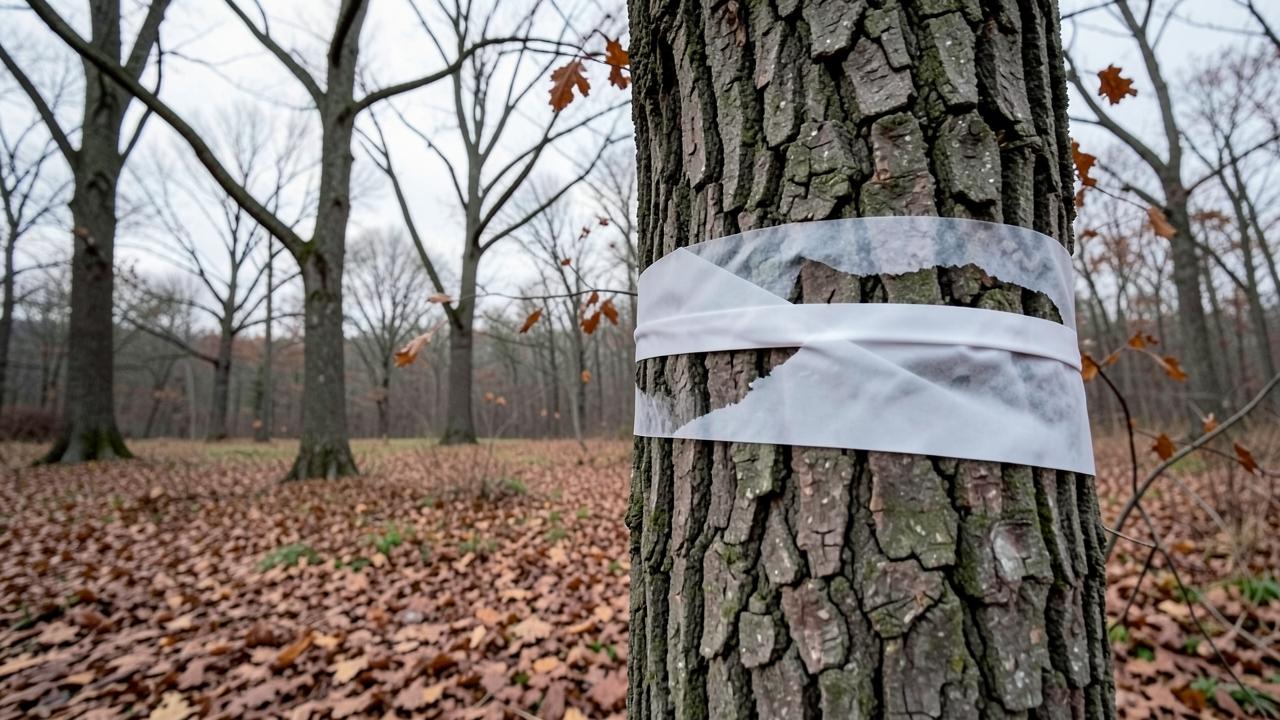
For most Cape Cod yards, no: sticky bands are not a reliable way to stop winter moth, and UMass Extension does not recommend them for reducing large populations. Bands are good for one thing, which is showing you whether a particular tree has a problem. On Cape Cod, the trees that can still justify the effort are fruit trees and blueberries, plus the odd prized specimen tree. Everywhere else, the useful work happens in April, not November.
The timing question comes up every year. Adult winter moths come out of the soil in mid to late November, usually before Thanksgiving, and keep flying on mild nights into January. That is when homeowners notice clouds of small tan moths around porch lights and start seeing banded trunks around town. Below we explain what is going on in your trees, what bands do and don't do, how to set one up properly if you still want to, and what protects your trees once the caterpillars hatch.
What winter moths are doing in your yard right now
Winter moth (Operophtera brumata) is a European insect. It was confirmed in Massachusetts in 2003 and spread across the South Shore onto Cape Cod and Martha's Vineyard over the following decade, according to the UMass Extension history of the outbreak. Its life cycle runs backwards compared with most pests, which is why it confuses people.
Here is the year as it plays out on the Cape, based on the UMass Extension identification and management fact sheet:
- Mid-November to January: adults come out of the soil. Males fly. Females have only stubby wings, so they walk up tree trunks (and sometimes house siding) to mate.
- Same period: each female lays roughly 150-350 eggs in bark crevices, under bark scales and in lichen, then dies. The adults do not feed and do no damage.
- Late March to mid-April: eggs turn from orange-red to blue, then blue-black, and hatch around bud break. Tiny caterpillars balloon on silk threads into the canopy and crawl inside swelling buds.
- April to early June: pale green inchworms feed on buds and new leaves. UMass notes that Cape Cod usually runs a week or two behind inland areas.
- Late May to June: full-grown caterpillars, about an inch long, drop to the soil and pupate there until November.
Is winter moth still a problem on Cape Cod?
Much less than it was ten years ago. Starting in 2005, UMass researchers released Cyzenis albicans, a parasitic fly that attacks winter moth and, according to the researchers, nothing else. By 2018 it had been released at 44 sites and was confirmed established at 38 of them, and the team reported that winter moth had been turned into a non-pest across much of its range (UMass Amherst news release).
The Cape Cod reports in UMass Extension's spring 2026 Landscape Messages say winter moth no longer causes widespread defoliation here. In recent seasons they noted minor defoliation in isolated areas of Barnstable, Falmouth, Harwich, Mashpee and Sandwich, probably from winter moth and fall cankerworm together. They also note that populations can still be high enough to damage apples and blueberries grown for fruit (UMass Landscape Message, May 1, 2026).
So on most properties, a few moths at the porch light in November are not a reason to act. A tree that was visibly stripped last spring, or a fruit planting, is a different story, and that is where monitoring pays off.
Do sticky tree bands actually work?
Bands are sold as a barrier: the flightless females climb the trunk, get stuck, and can't lay eggs in the canopy. UMass Extension says field results with bands are inconsistent and that bands are not recommended to reduce high populations. They recommend them for monitoring instead.
Mass Audubon's winter moth page lists the practical problems with bands:
- The sticky surface fills up with moths, leaves and debris and stops working quickly.
- Some insects get under the band where it doesn't seal against rough bark.
- Females that are stopped often lay their eggs right below the band, so the eggs are still on the tree.
- Newly hatched caterpillars can balloon in on the wind from neighboring trees and nearby woods, so one clean trunk doesn't protect a canopy that touches others.
If you band a tree, set it up to tell you something
A band is worth it if you treat it as a sampling tool on the one or two trees you care most about: an apple or crabapple, a blueberry planting, or a specimen oak or maple that lost leaves last spring. Done this way it tells you whether a spring treatment is worth the money.
UMass recommends putting bands up in late October. Early November is still workable on the Cape, because adults usually start emerging in mid-to-late November. Steps:
- Pick the right trees. Oak, maple and apple are the preferred hosts. Cherry, crabapple, ash, basswood, elm and blueberry are also attacked. Evergreens generally are not.
- Seal the gap first. Wrap a strip of fiberfill or batting snugly around the trunk at about chest height so there is no channel under the band.
- Wrap the band over it with the sticky side out, following the product's directions. Don't apply sticky material straight onto bark.
- Check it through December. A band covered in moths tells you the tree has a population worth watching. Replace or re-wrap it if it fills up.
- Look for eggs in late March to mid-April. Use a hand lens on the bark above and below the band. Orange-red eggs are not ready; blue eggs are close to hatching. That is your signal to start watching buds.
- Take the band down after you've done your spring egg check so it doesn't stay on the trunk through the growing season.
What protects your trees next spring
On healthy, established shade trees, a season of partial leaf loss is usually survivable. The trees at real risk are the ones hit year after year: Canadian research cited by UMass found that four straight years of partial defoliation can kill branches, and complete defoliation every year can kill the tree. Repeatedly weakened oaks also attract wood borers, bark beetles and Armillaria root rot.
Since the caterpillars feed in April and May, that is when decisions matter. A few points from the UMass guidance that homeowners often get wrong:
- Don't spray in fall. Fall oil sprays don't help because eggs are laid late in the season, and the adults can't be controlled at all since they don't feed.
- Dormant oil is for fruit growers. Oil only smothers eggs it covers directly. Eggs tucked in crevices and lichen survive, which makes it impractical on large landscape trees. UMass suggests it mainly for apple and blueberry plantings, applied above 45°F with no freeze for 24-48 hours afterwards.
- Scout in early to mid-April. Look for small holes in emerging leaves (UMass describes them as bullet-hole scrapes) and green inchworms in opening buds.
- If treatment is justified, timing beats product. For ornamental trees UMass advises waiting until the leaves have expanded. Bt (Bacillus thuringiensis kurstaki) works best on young caterpillars but also affects native butterflies and moths. Spinosad works on all sizes but is highly toxic to bees until dry, so it must not go on trees or plants in bloom.
- Leave the parasitic fly alone. Broad sprays can kill Cyzenis albicans, the reason winter moth numbers dropped. Spray only trees that clearly need it.
- Water stressed trees in dry spells. Mass Audubon notes extra water helps a defoliated tree recover while it pushes out a second set of leaves, which matters in Cape Cod's fast-draining sand.
Winter moth, fall cankerworm or Bruce spanworm?
You may be seeing more than one species. The moths at your window in late fall are not all winter moths, and the caterpillars in May are not all winter moth caterpillars either. UMass gives these field marks:
- Winter moth males: light brown to tan, with fringed hind wings and black dash marks forming a broken band near the wing tips. Females are gray with only short wing stubs.
- Fall cankerworm: males have a faint light patch on the front edge of each forewing. Females have no wings at all and are noticeably larger. Their eggs sit in tight, barrel-shaped rows around small twigs instead of being scattered on bark.
- Bruce spanworm: a native moth whose males look almost identical to winter moth. It is rarely a problem.
- Caterpillars: winter moth caterpillars have two pairs of prolegs at the rear. Fall cankerworm caterpillars have two and a half pairs, with a short first pair.
Fall yard work and trees that need a closer look
Winter moth pupae spend the summer and fall in the top layer of soil under host trees. UMass advises care when moving soil from under infested trees during fall transplanting or bed work, because you can carry pupae with it. If you are reworking beds under a big oak this month as part of a fall cleanup, keep that soil on the property.
A tree that has thinned out after several rough springs often has deadwood in the crown, which is a safety issue on its own. Late fall and winter, once the leaves are down, is a good time to see the structure clearly and remove dead limbs; our tree trimming guide explains the timing. If you're not sure whether a thin canopy is caterpillar damage, drought or something more serious, our tree services team can walk the property with you and say what needs attention now and what can wait. Requests for a free estimate can be sent any time of year.
Frequently asked questions
When do winter moths come out on Cape Cod?
Adults usually emerge from the soil in mid to late November, often before Thanksgiving, and stay active on mild nights into January. The caterpillars that do the damage hatch the following spring, usually from late March to mid-April, often a week or two later on the Cape than inland.
Are the moths at my porch light hurting my trees?
Not directly. Adult winter moths don't feed. The flying ones are males; the females can't fly and climb trunks to lay eggs. The damage comes from the caterpillars that hatch from those eggs in spring and feed on buds and new leaves.
Should I spray my trees for winter moth in the fall?
No. UMass Extension says fall oil sprays aren't useful because eggs are laid late in the season, and there is no control for the adults. If a tree needs treatment, it happens in spring when the caterpillars are small, after checking that they are actually present.
Which trees do winter moths attack?
Oak, maple and apple are the main hosts. Cherry, crabapple, ash, basswood, elm and blueberry are also attacked. Evergreens are generally left alone. Caterpillars can also drop onto roses and perennials growing under infested trees.
Is it too late to put up tree bands in November?
UMass recommends late October, but in early November there is usually still time on the Cape because the moths emerge in mid-to-late November. Remember that bands are a monitoring tool. They show whether a tree has a population worth watching in spring; they won't clear the tree of winter moth.
Related services
More from the blog
 Wood Ash on Your Lawn: A Cape Cod Guide for Fireplace SeasonFireplace ash can help an acidic Cape Cod lawn, but only in small doses, on the right soil and away from acid-loving shrubs. Here is how to tell if yours qualifies.
 Saltwater Flooding on Your Lawn: Cape Cod Recovery After a Storm TideA storm tide over the lawn is not always a death sentence. Here is what to do in the first days, what to leave alone over winter, and how to judge the damage in spring.
 Snow Plow Damage to Lawns: Stake Your Cape Cod Yard Before It FreezesMost plow damage happens because the driver cannot see where the pavement ends. A couple of hours with snow stakes in late November prevents most of it.
Want this done on your property?
Free estimates for landscaping, lawn care, and tree work across Cape Cod.