Signs a Tree Is Dangerous: A Cape Cod Check Before Winter Storms
By Nikola Popov, agronomist and founder of Sofkin Landscaping in Hyannis, MA
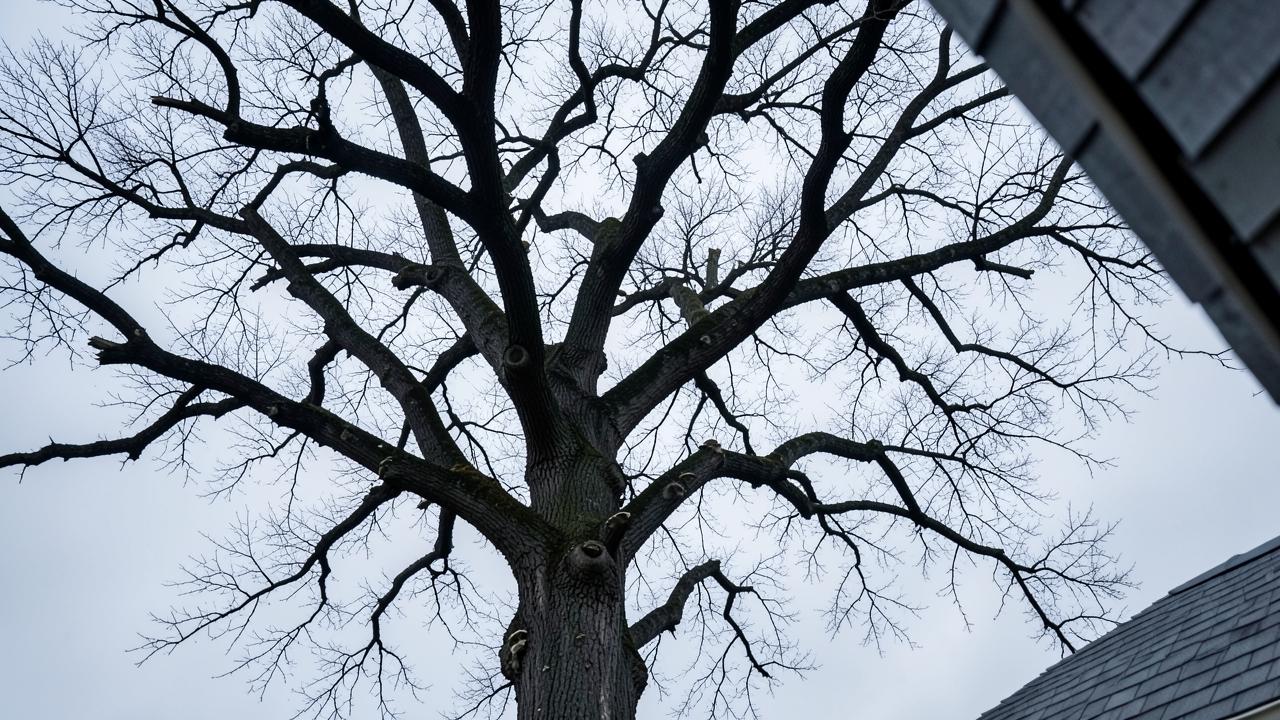
The signs a tree is dangerous are mostly visible from the ground: dead limbs, deep cracks, fungus on the trunk or roots, a tight V-shaped fork, a lean that is new, and soil lifting on one side of the base. If one of those sits over your house, driveway, deck or power line, it deserves a closer look before the winter storms arrive.
Late November is the best time on Cape Cod to do this check. The oaks and maples have dropped their leaves, so you can see the whole frame of the tree, and nor'easter season is still ahead. Below is what each warning sign means, how to walk your property in about 20 minutes, and how to tell a problem you can watch from one that should be handled this winter.
Why trees fail in a Cape Cod winter
A healthy tree can take a lot of wind. Trees usually fail when a storm finds a weak point that was already there: decay inside the trunk, a split fork, a dead limb, or roots that have lost their grip. Winter adds two things that summer storms do not.
First, weight. Wet snow and ice load every branch at once, and the load stays for hours or days. A limb with a weak attachment that survived a summer thunderstorm can tear out under a few inches of heavy snow. UMass Extension notes that tight, V-shaped unions with bark trapped between the stems are prone to failure under snow or ice loads (UMass Extension).
Second, long, wet storms. A nor'easter can blow from one direction for a day or more while rain soaks the ground. Saturated soil holds roots less firmly, and on exposed lots near the water the wind has nothing to slow it down. Trees that grew up sheltered by neighbors can also be suddenly exposed after nearby clearing or construction.
On the Cape, the trees we look at most are black and white oaks, pitch pines, white pines and older maples close to houses. Many oaks here went through years of defoliation and drought stress, and dead tops or dead limbs in those trees are common. None of that means a tree is coming down, but it is where to look first.
The warning signs that matter most
These are the defects arborists look for when they rate the chance a tree or limb will fail. Some are urgent on their own; others matter when they show up together.
- Dead wood. Branches with no buds, peeling bark or no twigs at the tips. UMass Extension suggests treating defective branches about 2 inches in diameter and larger as the ones that matter; smaller ones rarely cause harm.
- Hanging or broken limbs ("hangers"). A limb snapped in an earlier storm and caught in the canopy can drop at any time, including on a calm day.
- Cracks in the trunk or large limbs. Cracks that go all the way through, or cracks on two sides of the trunk, are considered very dangerous. A crack next to a cavity or decay is worse than either alone.
- Fungus. Mushrooms or shelf-like conks on the trunk, root flare or large roots usually mean decay inside. The visible part is small compared with the rot behind it.
- Weak forks. Two trunks of similar size joined in a tight V, especially with a seam of bark pressed between them. A wide, U-shaped union is stronger.
- A new lean or a moving root plate. A tree that has always leaned and corrected itself over time is usually fine. A lean that appeared recently, with cracked or mounded soil on the opposite side or roots lifting, is a warning sign of root failure.
- Damaged roots. Trenching, a new driveway, septic work or grade changes within the root zone in the last few years can show up as dieback in the crown or as instability later.
- Pitch pine trouble. Small popcorn-like blobs of resin on the bark and needles fading from green to yellow to orange are signs of southern pine beetle, which has reached Massachusetts and Cape Cod and attacks pitch and white pines (Provincetown Conservation Trust). A beetle-killed pine dries out and becomes brittle.
A 20-minute walk-around you can do this week
You do not need climbing gear to find most problems. Pick a dry, calm day, bring binoculars and your phone, and do this for every tree that could reach something you care about if it fell.
- Start with what is underneath. Stand at the house, driveway, deck, play area and the wires to the street. Any tree within roughly its own height of those spots goes on your list. Trees in the back of the woods with nothing under them can wait.
- Look at the whole tree from at least two sides. Walk all the way around. Cracks and cavities are often on the side you never see.
- Scan the crown with binoculars. Look for dead limbs, hangers, and branches with no buds. Compare the tree to its neighbors: a crown much thinner than the trees around it is a sign of stress.
- Check the trunk from the ground up to the first big limbs. Note cracks, open seams, cavities, oozing, bark falling off in sheets, and any fungus.
- Check the base and soil. Look for mushrooms at the root flare, soil cracking or heaving on one side, and roots that have been cut or buried.
- Take photos and write down the tree and the problem. Photos taken now make it easy to compare after the first big storm, and they give an arborist something concrete to look at.
- Do not climb, prune from a ladder, or touch anything near a wire. If a tree or limb is touching a power line, call the utility. This walk-around is for finding problems, not fixing them.
How to judge what is urgent
Tree risk is not only about how weak a tree is. Arborists weigh three things together: how likely the tree or limb is to fail, how likely it is to hit something when it does, and how bad that would be. The International Society of Arboriculture explains this approach for homeowners in its Recognizing Tree Risk guide.
In practice, that gives a simple order of priority:
- Handle before the next storm: a hanger over a walkway or driveway, a dead tree or large dead limb over the house, a crack through the trunk, a lean that is new with lifting soil.
- Have it assessed this winter: fungus at the base of a tree near the house, a split V-fork above the roof, a pine with fading needles or resin blobs, dieback in a tree that had root work nearby.
- Watch and recheck in spring: small dead twigs, an old lean that has corrected itself, defects in trees with nothing under them.
What an arborist can do besides cutting it down
A warning sign does not always mean removal. UMass Extension points out that trees with a few broken branches or a broken leader can often be saved with pruning, and that the assessment should be done by a qualified inspector, ideally a Massachusetts Certified Arborist (UMass Extension). The common options are:
Each option has a cost and a limit. Cabling buys time for a valuable tree but needs periodic inspection. Crown reduction done badly turns into topping, which creates more weak growth; our tree trimming guide explains why. Removal is the right call when the trunk or roots are failing, or when the tree is dead and close to the house.
If the tree is near a wetland, pond or the shore, ask about permits before work starts. Many Cape towns require conservation commission review for tree work within wetland buffer zones, even for a hazard tree, and the process varies by town. Our post on land clearing permits covers how that usually works.
- Removing dead wood and hangers so the rest of the tree is safe.
- Reduction pruning to shorten long, heavy limbs that reach over a roof.
- Cabling or bracing a weak fork so the two stems cannot spread apart in a storm.
- Removal of the whole tree, in sections, when the defect is in the trunk or roots.
Seasonal homes: plan for the months you are away
If you close the house for the winter, a limb on the roof can go unnoticed for weeks, with snow and rain getting in through the damage. Do the walk-around before you leave, and schedule any urgent work while you can still be reached.
Ask a neighbor or caretaker to drive by after major storms, and give them your photos so they know which trees you were worried about. If you have an arborist's report, keep a copy with your insurance documents. Coverage for fallen trees depends on your policy and on what happened, so read the tree and debris-removal sections now rather than after a storm.
It also helps to note trees already stressed by insects. Oaks hit repeatedly by caterpillars are more likely to carry dead limbs; our winter moth guide explains which trees on the Cape are at risk.
Get a second pair of eyes before the storms
If your walk-around turned up something over the house, or you are not sure what you are looking at, our tree services team can look at the trees around your home and tell you what can wait, what needs pruning and what should come down. To book a visit, request a free estimate.
If you would rather find an independent arborist for a written risk assessment, the Massachusetts Arborists Association lists Massachusetts Certified Arborists.
Frequently asked questions
How can I tell if a tree is going to fall?
You cannot predict it exactly, but the strongest warning signs are a lean that appeared recently with soil cracking or lifting on the other side, cracks through the trunk, large cavities, and fungus at the base. If a tree shows any of these and could hit your house or a driveway, have an arborist look at it.
Is a leaning tree always dangerous?
No. Many trees lean toward light and grow that way for decades, curving back upward over time. A lean is a concern when it is new or getting worse, especially after a storm, or when roots and soil are lifting on the side away from the lean.
Are mushrooms at the base of a tree a bad sign?
Usually, yes. Mushrooms and shelf fungi on the root flare or trunk often mean decay inside the wood or roots. The tree may still look full and green. It needs an assessment to find out how much sound wood is left.
Is winter a good time to remove or prune a tree on Cape Cod?
For most trees, the dormant season works well: the structure is easy to see, the ground is firmer for equipment once it freezes, and the lawn and beds take less damage. Urgent hazards should be handled whenever they are found, regardless of season.
Who is responsible if my tree falls on my neighbor's house?
It depends on the circumstances and your insurance policy, and the rules are a legal question, not a landscaping one. Ask your insurance agent. What you can control is finding and fixing obvious defects, like a dead tree near the property line, before a storm does it for you.
Related services
More from the blog
 Wood Ash on Your Lawn: A Cape Cod Guide for Fireplace SeasonFireplace ash can help an acidic Cape Cod lawn, but only in small doses, on the right soil and away from acid-loving shrubs. Here is how to tell if yours qualifies.
 Saltwater Flooding on Your Lawn: Cape Cod Recovery After a Storm TideA storm tide over the lawn is not always a death sentence. Here is what to do in the first days, what to leave alone over winter, and how to judge the damage in spring.
 Snow Plow Damage to Lawns: Stake Your Cape Cod Yard Before It FreezesMost plow damage happens because the driver cannot see where the pavement ends. A couple of hours with snow stakes in late November prevents most of it.
Want this done on your property?
Free estimates for landscaping, lawn care, and tree work across Cape Cod.